Resume vs CV: What’s the Difference?
Not sure whether to submit a resume or CV? Learn the key differences, when to use each, and how to structure both documents to land your next opportunity.
Introduction
In your job search, understanding the distinction between a resume and a CV (Curriculum Vitae) can significantly impact your success. As a career coach, I’ve witnessed the confusion that arises when professionals aren't sure which document to use. The terms are often used interchangeably, but they serve different purposes and formats. Knowing the right document to submit can not only streamline your application process but also increase your chances of securing that coveted interview.
In this blog post, we'll dive deep into the question: "Resume vs CV: What’s the Difference?" By the end, you’ll be equipped with actionable insights and tips to tailor your application materials effectively.
1. Defining the Resume
A resume is typically a concise document, usually one to two pages, summarizing an individual's professional qualifications, work experience, skills, and education.
Key Characteristics of a Resume
- Length: One to two pages in length.
- Focus: Tailored for specific job applications.
- Format: Often bullet-pointed for easy scanning.
- Content: Includes contact information, work history, education, and relevant skills.
Example
For instance, if you're applying for a project management position, your resume would prominently feature your project management experience, relevant certifications, and key skills necessary for the position.
For more information about resumes and formatting, check out Indeed's Career Guide.
2. Understanding the CV
The Curriculum Vitae (CV) originates from Latin, meaning "course of life." It's a more comprehensive document, often exceeding two pages, detailing an individual’s entire career history, including academic achievements, publications, and other significant accomplishments.
Key Characteristics of a CV
- Length: Often multiple pages (no strict limit).
- Focus: A comprehensive overview of one’s education, professional experience, and skills.
- Format: Usually chronological or functional format.
- Content: Includes academic credentials, research, publications, teaching experience, and professional memberships.
Example
For an academic position, a CV is essential as it reflects both your academic and professional journey, including courses taught, papers published, and conferences attended.
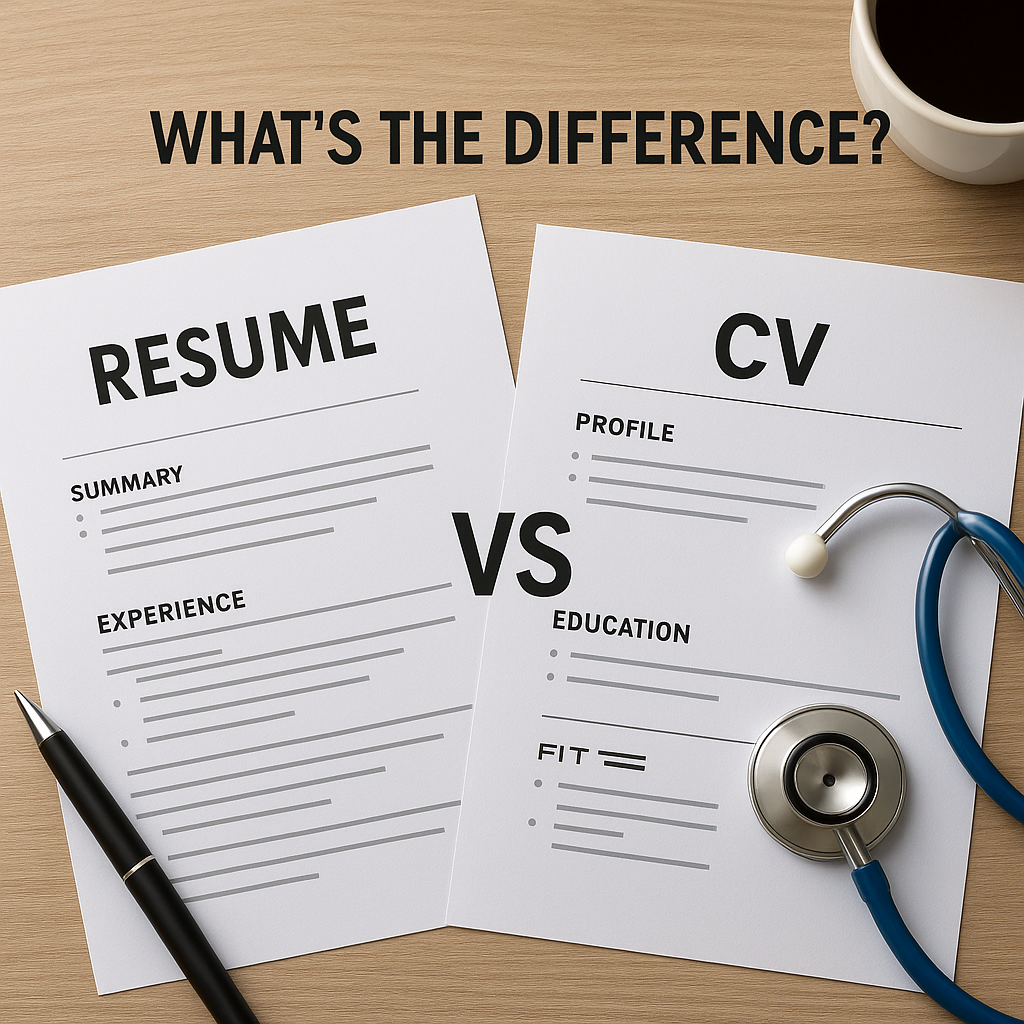
3. Key Differences Between a Resume and CV
Understanding the differences ensures you're putting your best foot forward in your job applications. Here are the key distinctions:
Length and Detail
- Resume: Concise, focused on job-specific qualifications and experience.
- CV: Detailed, comprehensive, includes extensive background.
Usage Context
- Resume: Common in the U.S. for private sector positions.
- CV: Standard in academia, research, and when applying internationally.
Customizability
- Resume: Highly customizable per job application.
- CV: Fixed content that may be less frequently altered.
Example Scenario
If you're applying for a university professorship in biology, a CV showcasing your research, publications, and teaching trajectory is necessary. Conversely, if you're applying for a corporate management role, a resume highlighting your relevant experience will be more effective.
For additional context on the job market's preferences for resumes vs CVs, see the Bureau of Labor Statistics.
4. When to Use a Resume vs a CV
The decision of whether to use a resume or CV often depends on the industry and job level. Here’s a quick guide:
Use a Resume When:
- Applying for most corporate positions in the U.S.
- Job postings request a “resume” or “application.”
Use a CV When:
- Pursuing academic roles or positions in research.
- Applying for roles that require comprehensive academic histories, such as research institutions.
- Applying in countries where CVs are the norm (e.g., Europe, academic positions).
Example
If you're a recent graduate applying for an entry-level marketing role, a tailored resume emphasizing internships and relevant skills would suffice. But, if you have a Ph.D. seeking a university faculty position, prepare a detailed CV highlighting your academic journey.
5. Structuring Your Resume and CV
Different documents demand different structures. Here’s how to effectively structure both:
Key Sections for a Resume
- Contact Information: Name, phone number, email, LinkedIn.
- Summary or Objective: Brief personal pitch tailored to the role.
- Work Experience: Relevant experiences in reverse chronological order.
- Education: Degrees, institutions, graduation dates.
- Skills: Bullet-pointed lists of critical skills required for the job.
Key Sections for a CV
- Contact Information: Same as resume.
- Education: Detailed accounts of academic qualifications.
- Research and Teaching Experience: Relevant academic roles, research projects.
- Publications and Presentations: List of published papers or conference talks.
- Professional Affiliations: Memberships in professional organizations.
Example of Structuring
Consider Sarah, a recent graduate. For her marketing internship, she uses a resume; however, for applying to graduate school, her CV includes detailed project work, thesis information, and any published work.
To gain more insight, consult Professional Resume Templates.
6. Practical Examples from Different Industries
Let’s explore how resumes and CVs differ across various fields.
Technology Sector
In tech, a resume is preferred when applying for software developer roles. It should emphasize technical skills like programming languages, project work, and internships.
Education Sector
Conversely, a CV is mandatory for teachers and professors. It outlines educational background, teaching philosophy, and academic publications.
Case Study
Consider Mark, who transitioned from engineering to education. As an engineer, he crafted a precision-focused resume highlighting his projects. Upon entering academia, he shifted to a CV format that illustrated his teaching experience and research developments.
7. Common Questions and Misconceptions
When creating your career documents, you may have questions. Here are some common inquiries:
Are Resumes and CVs the Same?
No, they serve different purposes and target different job markets as discussed.
Should I Always Include a CV or Resume with My Application?
Most U.S. job contexts require a resume; however, academic and research positions will request a CV.
Is It Okay to Include Personal Information?
It is typically acceptable to include your contact information, but avoid unnecessary personal details due to privacy concerns.
8. Step-by-Step Tips for Crafting Your Document
To ensure you create an effective resume or CV, follow these actionable tips:
- Tailor Your Document: Customize your content for each application to highlight relevant experience.
- Use Keywords: Incorporate keywords from the job description to get noticed by ATS (Applicant Tracking Systems).
- Quantify Achievements: Use metrics to showcase your impact (e.g., “Increased sales by 30%”).
- Keep It Professional: Use a clean, professional layout, and avoid flashy fonts or colors.
- Proofread: Ensure there are no grammatical errors or typos. A second pair of eyes can help!
Conclusion and Key Takeaways
Understanding the differences between a resume and a CV is crucial for anyone navigating the job market. Key takeaways include:
- A resume is tailored and concise, while a CV is comprehensive.
- Use a resume for most jobs in the private sector and a CV for academic and research roles.
- Structure both documents according to industry standards.
Are you ready to create your standout document? Build your resume today using our free resume builder and transform your job search!
FAQs
What type of document is better for entry-level positions?
A resume is typically more suitable for entry-level jobs in most industries.
Can I mix elements of a resume and a CV?
While you shouldn’t mix them, you can take structural inspiration from one to enhance the other as needed.
Should I update my CV more frequently than my resume?
Yes, especially if you’re in academics or research; a CV should continually reflect your latest achievements.
How often should I revise my resume for different job applications?
Your resume should be tailored and updated for each specific job application you submit.
Is there a standard format or template I should follow?
While you can find templates, it’s best to customize your format according to your industry’s conventions and your personal style.